Digital Input/Output is provided
by a 6522 Versatile Interface Adapter
(VIA).
The
VIA offers us two 8bit ports, of which every line can be
individually configured to be an input or an output. Four
additional lines are provided, and these may be set to
generate an interrupt if triggered.
Within Amélie, it is usual that port A is used
as inputs (for sensing) while port B is used as outputs (for
driving motors, relays, etc).
Also
contained within the VIA are two 16bit timers. The first of
these is configured to cause an interrupt at 50Hz (or every
two centiseconds). This is used to maintain a system 'clock'
and control various time-dependant things.
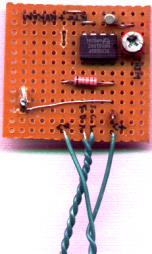 It
should be noted that port A lines
six and seven are reserved for the implementation of a basic I2C
(or IIC) bus. This is provided to talk to an RTC/NVRAM part,
as you can see in the
picture.
It
should be noted that port A lines
six and seven are reserved for the implementation of a basic I2C
(or IIC) bus. This is provided to talk to an RTC/NVRAM part,
as you can see in the
picture.
The
little circuit shown is a Philips PCF8583P. This can act as a
real-time clock with 240 bytes of NVRAM, or as 256 bytes of
NVRAM. Salvaged from an old VCR, this part happens to be the
same as is used in the 'Archimedes' range of computers.
All
that is missing from this circuit, and the big space on the
board, is the battery - though there is no reason why two AA
cells cannot be wired in (in a holder) with a diode to prevent
accidental
charging.